WhatsApp Business vs Online Store: Which is Better in Ghana?

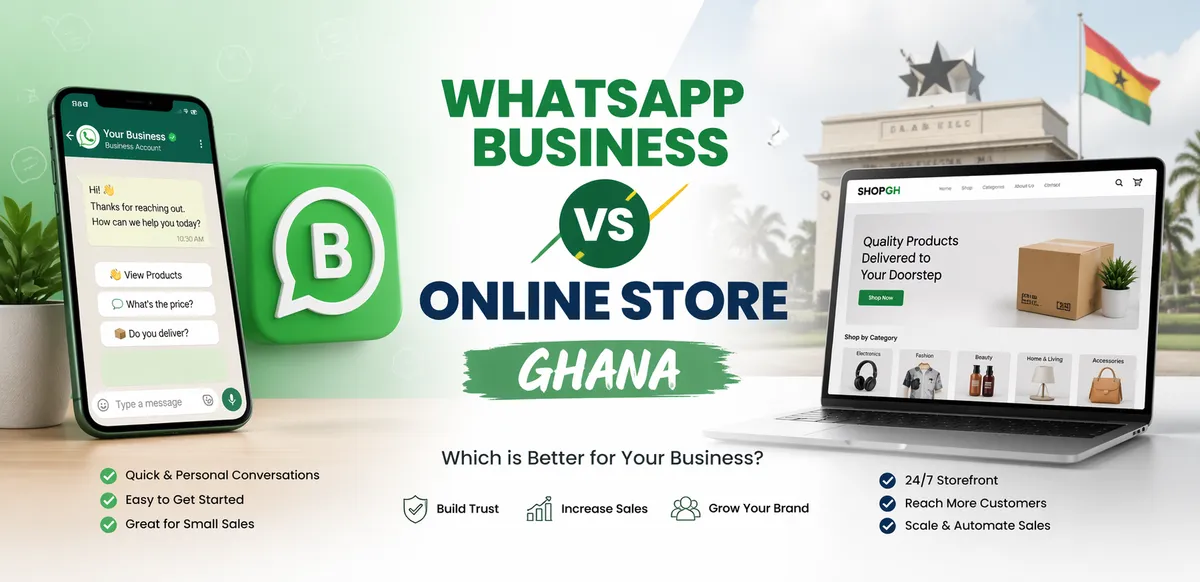
Ask any Ghanaian seller this question and you will get strong opinions on both sides. WhatsApp sellers will tell you their business runs fine without a website — and they are often right, up to a point. Online store advocates will tell you WhatsApp is chaotic and unscalable — and they are also right, eventually.
The honest answer is that WhatsApp Business and an online store solve different problems. One is a conversation channel. The other is a transaction system. Understanding exactly what each does well — and where each falls short — is how you make the right call for where you are right now.
15M+ — Internet users in Ghana (Statista, 2025)
This article walks through both channels honestly: the real advantages, the real limitations, and a clear framework for deciding what to use at what stage. And if you want the full guide on setting up WhatsApp Business properly, start with how to sell on WhatsApp in Ghana.
How Ghanaians Actually Sell Today
The typical Ghanaian seller’s journey starts on WhatsApp. It costs nothing, it is already on every customer’s phone, and the barrier to start is near-zero. Post a product photo on WhatsApp Status, a contact replies asking about it, you quote a price, they send their mobile money number, you confirm the screenshot, you pack and deliver.
At five or ten orders a week, this works. The problems start to stack up as volume grows:
- An order comes in while you are busy. By the time you reply, the customer has moved on.
- A payment screenshot gets buried in a conversation thread. You are not sure if it was for this order or the previous one.
- A customer asks about their delivery status. You have to scroll back through 40 messages to find their address.
- Someone sends to the wrong mobile money number. Now you have a dispute and a frustrated customer.
None of these are failures of effort. They are structural limitations of using a messaging app as an order management system. WhatsApp was built for conversation. It was not built for commerce.
Where WhatsApp Business Wins
WhatsApp Business has genuine strengths that no online store can fully replicate. Understanding them helps you use the channel deliberately rather than just habitually.
Free — WhatsApp Business has no platform cost
Zero cost to start
The WhatsApp Business app is free. No monthly subscription, no transaction fees, no hosting cost. For a seller just starting out, this matters. You can test a product, build an audience, and make your first hundred sales without spending a cedi on platform fees.
Customers are already there
You do not need to convince Ghanaian customers to download a new app or visit a new website. WhatsApp is already open on their phone, probably multiple times a day. When you send a customer a product photo on WhatsApp, they see it in the same app where they chat with family. That familiarity reduces friction in a way a website never can.
Personal trust builds faster
A WhatsApp conversation feels personal. Customers can see that a real person is responding. They can send a voice note. They can negotiate. They can ask “do you have this in size 14?” and get an immediate answer. This kind of relationship-building is genuinely valuable — especially for high-consideration purchases where customers want to feel they are buying from someone they know, not a faceless website.
WhatsApp Status is free daily reach
Every contact who has your number saved sees your WhatsApp Status by default. Unlike Instagram or TikTok, where the algorithm decides whether to show your content, WhatsApp Status goes directly to your full contact list. Post daily — new arrivals, flash sales, restocks — and you have a free marketing channel that reaches everyone who has ever bought from you or enquired about your products.
Built-in business tools
WhatsApp Business includes Quick Replies (preset answers to common questions), Labels (colour-coded conversation tracking), a product Catalogue, automated Greeting and Away messages, and broadcast lists for sending messages to up to 256 contacts at once. These tools are enough to run a tidy operation at low volumes.
Where WhatsApp Business Holds You Back
WhatsApp Business was not designed as a sales platform. Its limitations are not bugs — they are simply the result of using a communication tool to do something it was never built to do.
No checkout, no payment system
WhatsApp has no built-in checkout. Every single order is a manual negotiation: confirm the product, confirm the price, share your mobile money number, wait for the customer to send payment, screenshot the confirmation, verify it matches the order amount, confirm delivery details. This process takes roughly ten minutes per order. At thirty orders a day, that is five hours of daily admin — before you have packed a single item.
Fake mobile money confirmations and payment fraud
When you collect payment by sharing your mobile money number, the only way to confirm payment is to check your mobile money balance or wait for the SMS notification. Fraudsters exploit exactly this gap. A buyer sends you an edited screenshot showing a successful transfer that never happened. Under time pressure — especially when you have multiple orders coming in at once — it is easy to miss. You pack the order, send it out, and only discover the fraud when you check your balance later.
This is not a rare edge case. Fake mobile money confirmation screenshots are a known and growing problem for Ghanaian sellers who accept manual mobile money payments. With a proper payment link, the order is only created after payment clears programmatically — there is no screenshot to fake, no balance to manually verify, and no window for this type of fraud.
Orders disappear into conversations
Every customer has their own chat thread. At volume, orders are scattered across dozens of conversations with no unified view. There is no order list, no status tracking, no way to see at a glance what has been paid, what is packed, and what is pending delivery. Sellers who scale past WhatsApp inevitably describe the same experience: “I was losing orders in the chats.”
No customer database
WhatsApp has no built-in way to export or analyse your customer list. You cannot segment customers by purchase history, see who your most loyal buyers are, or send a targeted message to everyone who bought a specific product. Your customer data lives in chat threads, not in a system you control.
Catalogue limit of 500 items
The WhatsApp Business catalogue supports a maximum of 500 products with no variants (no sizes, colours, or options within a single listing) and no stock tracking. If you sell more than a few hundred SKUs, or if your products have variants, the catalogue will not hold your full range.
500 — Maximum products in WhatsApp Business catalogue
No organic discovery
A new customer cannot find your WhatsApp business by searching Google. They cannot stumble across your products on a marketplace. The only way someone becomes your WhatsApp customer is if they already have your number — from a friend, a flyer, a social media post, or a previous interaction. WhatsApp is a brilliant retention channel. It is a terrible acquisition channel.
Broadcasts capped at 256 contacts
WhatsApp Business broadcast lists are limited to 256 contacts per list, and messages are only delivered to contacts who have your number saved. As your customer base grows past a few hundred people, broadcast becomes an increasingly limited tool.
Accounts get banned with no warning
WhatsApp suspends Business accounts without notice and without clear explanation. It can happen because too many contacts reported your number, because your messaging pattern triggered a spam detection algorithm, or for reasons WhatsApp never discloses. When it happens, you lose access to your entire customer conversation history, your broadcast lists, your catalogue, and your ability to receive or send any messages — instantly. Appeals can take days or weeks, with no guaranteed outcome.
For a seller whose entire business runs through a single WhatsApp number, a suspension is not an inconvenience. It is a full business shutdown until Meta decides to reinstate the account — if they ever do.
Platform dependency
Even without a ban, your WhatsApp business exists entirely on Meta’s infrastructure. If Meta changes its terms, introduces fees for the Business app, or simply has a bad day technically, your ability to trade stops. You do not own the channel. You are a tenant on someone else’s platform.
Meta’s October 2021 outage took WhatsApp offline for six hours globally. Sellers with an online store kept receiving orders through their website the entire time. Sellers whose business existed only on WhatsApp had no channel at all.
Where an Online Store Wins
An online store solves precisely the problems WhatsApp cannot. It is not a replacement for WhatsApp — it is the infrastructure that sits behind it.
GHS 4.54T — Mobile Money transactions in Ghana in 2025 (Bank of Ghana)
Proper checkout with Mobile Money integration
A customer clicks a product link, adds to cart, selects a delivery option, and pays by MTN MoMo, Vodafone Cash, or AirtelTigo Money — all in one flow. Payment is confirmed automatically. An order is created in your dashboard. The customer receives an SMS and email receipt. You get a notification. No back-and-forth. No screenshot verification. The scale of Mobile Money in Ghana — GHS 4.54 trillion in 2025 transactions — means every customer already has a wallet. They just need a checkout to use it properly.
Unified order management
Every order — whether the customer came from WhatsApp, TikTok, or a Google search — lands in the same dashboard. You can see every order, its payment status, delivery status, and customer details in one place. Mark orders as packed, dispatched, and delivered. Generate delivery labels. Process batches of orders at once. The system that would take you five hours a day to manage manually in WhatsApp takes fifteen minutes in a proper order management tool.
Automated receipts and confirmations
When a customer pays through your store, they receive an SMS and email receipt automatically. When their order ships, they receive an update. This level of communication builds trust and reduces the “where is my order?” messages you would otherwise be answering manually on WhatsApp.
Shareable payment links — without needing a website
This is the part most sellers do not know: you do not need a branded website to get the benefits of a proper checkout. On Nuanom’s free plan, every product in your store has a shareable payment link. Copy the link from the merchant app and paste it directly into WhatsApp — the same way you currently share a product photo. The customer clicks the link, pays by Mobile Money, and the order is created automatically. You do not need a custom domain. You do not need a website. You just need the link.
SEO and organic discovery
Once you use your branded website — included on every Nuanom plan, including Free — your products become discoverable on Google. A customer searching for “ankara fabric Accra” or “phone case Samsung Galaxy Ghana” can land on your product page without ever having heard of you. This is the acquisition channel that WhatsApp cannot provide. For a full guide on setting up the store side, read how to start an online shop in Ghana.
Scale without adding headcount
Processing 100 orders through a proper order management system takes roughly the same time as processing 10. Processing 100 orders through WhatsApp takes ten times as long as processing 10. The only way to scale a WhatsApp-only operation is to work more hours or hire someone to manage the chats — neither of which is a real solution.
The Real Cost of Selling Only on WhatsApp
The hidden cost of WhatsApp-only selling is time. Each order through WhatsApp takes roughly ten minutes to process end-to-end: confirming the product and price, sharing your mobile money number, waiting for payment, verifying the screenshot, confirming the delivery address, and manually logging the order somewhere so you do not forget it.
5 hrs — Daily admin time for 30 WhatsApp orders at 10 mins each
At thirty orders a day — not a large operation by any standard — that is five hours of daily admin. Five hours that could go toward sourcing better products, building your marketing, or simply living your life. For the step-by-step system that eliminates this admin, read how to track orders and customers on WhatsApp without stress.
Beyond time, there is the cost of orders that never happen at all. A customer who messages you at 11pm and gets no reply until morning often does not come back — they found another seller who responded. A customer who asks for the price and has to wait for you to reply may decide it is too much effort and not bother. WhatsApp selling is only as fast as you are personally available.
And then there is the growth ceiling. Your WhatsApp business is tied to your personal number and your personal responsiveness. You cannot easily hand it to a staff member. You cannot automate it without the WhatsApp Business API (which requires a third-party provider and costs money). The ceiling is low, and it arrives earlier than most sellers expect.
Which One is Right for You?
The answer depends on where you are in your business. Here is a clear framework:
- If you are just starting (fewer than 10 orders a week): WhatsApp Business is a perfectly fine place to start. It costs nothing and it is where your first customers already are. But even at this stage, setting up a free Nuanom store gives you shareable payment links so customers can pay by Mobile Money directly — no mobile money screenshot-chasing needed. No website required.
- If you are getting 20 or more orders a week: You need proper order management. Not a website — just a system so orders do not get lost in chat. A free or Basic Nuanom plan handles this. WhatsApp stays as your communication channel. The store handles payment and order tracking.
- If you want new customers to discover you on Google: Now you need a branded website. Every Nuanom plan includes one with fully indexed product pages, and paid plans let you use your own domain. WhatsApp only reaches people who already know your number. A website reaches everyone searching for what you sell.
- If you sell high-value products where trust matters: A professional storefront on your own domain signals legitimacy in a way a WhatsApp number cannot. Customers spending GHS 500 or more on a single item want to see that your business is real. A branded website is that signal. Nuanom PRO and PRO+ give you a fully branded storefront on your own domain.
- If you sell more than 500 products: WhatsApp’s catalogue cap is a hard wall at 500 items, with no support for product variants. Nuanom has no practical product limit on any plan.
The Winning Setup: Use Both Together
The best Ghanaian sellers do not choose between WhatsApp and an online store. They use WhatsApp to communicate and Nuanom to transact.
Start free — no website needed
On Nuanom’s free plan, every product in your store has a shareable payment link. Here is the workflow:
- List your products in Nuanom (takes minutes — the merchant app has AI-assisted product descriptions).
- Open any product and copy the shareable link from the options menu.
- Paste the link into your WhatsApp Status post, directly into a customer chat, or into a WhatsApp group.
- The customer clicks, pays by MTN MoMo, Vodafone Cash, or AirtelTigo Money, and the order is created in your dashboard automatically.
- The customer receives an SMS and email receipt. You get a notification. No screenshots. No manual verification. No back-and-forth.
You keep everything that makes WhatsApp great — the personal conversations, the daily Status reach, the relationship warmth — and you eliminate everything that makes it painful at scale.
Upgrade to a website when you are ready
When you are ready for Google to find you, upgrading to a Nuanom PRO or PRO+ plan adds a branded website on your own custom domain. Your existing products, orders, and customers carry over automatically. WhatsApp keeps working exactly as before. You just added a new discovery channel on top. See the full plan comparison to decide when the upgrade makes sense for your volume.
Automate your WhatsApp with an AI agent
Once your Nuanom store is live, you can add a WhatsApp AI Assistant that handles all inbound WhatsApp messages automatically. It knows your product catalogue, your prices, your stock levels, and your delivery areas — because it is connected directly to your Nuanom store. When a customer asks “do you have this in blue?”, the AI answers. When they want to order, the AI sends the payment link. When they ask about delivery, the AI updates them. You wake up to paid orders that came in while you slept.
Add a branded app to retain your best customers
WhatsApp brings customers in. A branded mobile app brings them back. Push notifications for new arrivals and restocks reach customers directly on their phone — without needing them to have your number saved or to check your WhatsApp Status. It is the next layer of retention once your WhatsApp audience is established.
WhatsApp is where Ghanaian commerce happens. The question is never whether to use it — it is whether to keep doing it manually or to add the infrastructure that makes it sustainable at scale.
Ready to stop chasing mobile money screenshots? Start a free Nuanom store and connect it to your WhatsApp in minutes — shareable payment links, Mobile Money and card payments, and automated order management, all included at no cost.
Frequently asked questions
Is WhatsApp Business enough to run a full business in Ghana?
WhatsApp Business is enough to start — many Ghanaian sellers make their first sales entirely through it. But it has hard limits: no checkout, no payment processing, no order history, and no way for customers to find you unless someone gives them your number. As soon as you are regularly getting 10 or more orders a day, managing them in WhatsApp chats becomes a full-time job on its own. Adding a free Nuanom store gives you shareable payment links and automated order management, so WhatsApp can go back to doing what it does best — building relationships.
What are the biggest limitations of WhatsApp Business for selling?
The biggest limitations are no built-in checkout or payment, no customer database, no order history, and no way for new customers to discover you through search. Every order requires back-and-forth to confirm products, confirm payment, and confirm delivery. WhatsApp also has a 500-item catalogue limit, broadcasts are capped at 256 contacts, and if WhatsApp changes its terms or goes down, your entire sales channel disappears.
Do I need an online store if I already sell on WhatsApp?
You don’t need a website — but you do need proper payment and order management. Nuanom’s free plan gives you shareable product payment links that you can paste directly into WhatsApp. Customers click the link, pay by Mobile Money, and the order is created in your dashboard automatically. No more MoMo screenshots, no more orders buried in chat threads. You get a receipt system too — customers receive SMS and email confirmation without you lifting a finger. A branded website (for SEO and Google discovery) is available on PRO and PRO+ plans when you’re ready.
How much does an online store cost in Ghana?
Nuanom’s free plan includes a store, shareable payment links, Mobile Money and card payments, automated order management, and receipts — no website required. Paid plans add more products and features while still keeping everything WhatsApp-friendly. A branded website on your own custom domain starts with the PRO plan at GHS 6,999 per year. Most sellers start free and upgrade once the volume justifies it.
Can I use WhatsApp Business and an online store at the same time?
Yes, and this is how the best Ghanaian sellers operate. Use WhatsApp for relationship-building, daily Status posts, and responding to questions. Send customers your Nuanom product links for checkout — they pay by Mobile Money directly on the product page, the order appears in your dashboard automatically, and you get a notification. You keep the warmth of WhatsApp while the online store handles the parts WhatsApp was never built to do.
Which is better for getting new customers — WhatsApp or an online store?
An online store is far better for finding new customers. Product pages are indexed by Google — a customer searching for “women’s kaba in Accra” can find your store without knowing you exist. WhatsApp only reaches people who already have your number. Think of your online store as your discovery channel and WhatsApp as your relationship channel. Build both.
What happens to my business if WhatsApp goes down?
If you sell exclusively on WhatsApp and it goes down — even for an hour — your entire business stops. This has happened before: Meta’s October 2021 outage took WhatsApp offline for six hours globally. Sellers with an online store kept receiving orders through their website during the entire outage. Platform dependency is a real business risk. An online store on your own domain is an asset you own and control.
Can customers pay on WhatsApp without Mobile Money?
WhatsApp itself has no payment system in Ghana — you have to ask customers to send money to your Mobile Money number manually and then verify the screenshot yourself. With Nuanom, customers pay by MTN MoMo, Vodafone Cash, or AirtelTigo Money directly on the product page — the payment is confirmed automatically, no screenshot verification needed. Nuanom also supports card payments for customers who prefer that.

Related